










After arriving
Starting a new chapter in a new country is exciting, but it can also be confusing. Life in Haugalandet starts with a few essentials, and knowing where to begin can make all the difference.
Whether you’re here to work, study, or join family, getting started in Norway can feel overwhelming – but it doesn’t have to be.
On this page, you’ll find practical information and trusted links to help you navigate everyday life in Haugalandet. From ID numbers and healthcare to opening a bank account and learning Norwegian, we’ve gathered the essentials in one place so you can settle in smoothly.
Getting an ID number
To settle into life in Norway, one of the first things you’ll need is a Norwegian ID number. It’s used for all kinds of practicalities – like opening a bank account, getting paid, and going to the doctor.
There are two types of ID numbers:
- National identity number (for long-term stays)
- D-number (for shorter stays)
Your ID number depends on how long you’re planning to stay, and makes everyday life a whole lot easier.
The Norwegian Tax Administration (Skatteetaten) is responsible for the National Population Register and provides the information you need to obtain your ID number:
The Norwegian Directorate of Immigration (UDI) is responsible for processing applications from foreign nationals who wish to visit or live in Norway:
Haugesund kommune has made a checklist of your journey starting a new life in the area. In addition to a residence permit and an ID number, some of the things include applying for a tax card, opening a bank account and buying insurance policies. Check it out here:
Opening a bank account
Once you have your Norwegian ID number, you can open a bank account. You’ll need it to receive your salary, pay bills, transfer money – and basically manage life in Norway.
To open an account, you usually need to visit the bank in person and bring a few key documents:
- A valid passport
- Your Norwegian ID number (national identity number or D-number)
- A work contract
- Your residence permit (if you’re from outside the EU/EEA)
Some banks might ask for additional documentation, so it’s a good idea to check with them in advance.
Once your account is set up, you can also apply for BankID, Norway’s secure electronic ID. It allows you to log into most public services, sign documents digitally, and do online banking. If you already have BankID from another Norwegian bank, opening a new bank account can be even easier.
Banks with locations across Haugalandet include:
- Haugesund Sparebank (Haugesund, Etne, Tysvær, Sveio, Skjold, Ølen)
- Skudenes & Aakra Sparebank (Åkrehamn, Kopervik, Oasen, Skudeneshavn, Veavågen)
- Sparebank 1 Sør-Norge (Haugesund, Tysvær, Ølen, Bygnes)
- Handelsbanken (Haugesund)
- DNB (Haugesund)
- Sparebanken Norge (Haugesund, Etne, Sauda)
- Nordea (Haugesund)
Banks with websites in English are Sparebank 1 Sør-Norge, Handelsbanken, DNB, Sparebanken Norge and Nordea.
Paying taxes in Norway
If you’re working in Norway, you’ll need a tax deduction card. This tells your employer how much tax to deduct from your salary.
Most foreign workers are placed in a simplified system called PAYE, where a fixed percentage (usually 25%) is automatically deducted. If you’re part of this system, you don’t need to submit a tax return.
Want to learn more or check which tax system applies to you? Read more at The Norwegian Tax Administration (Skatteetaten):
Healthcare in Norway
Once you’re registered in the National Population Register as a resident in a Norwegian municipality, you’ll normally be assigned a GP (fastlege) – your regular doctor. This is the first person to contact if you get sick or need medical advice. If you’re staying short-term and only have a D-number, you might not be entitled to a GP.
Healthcare in Norway isn’t free, but the costs are relatively low. You’ll usually pay a user fee (egenandel) when seeing a doctor or using other public health services. The fee typically ranges from NOK 150 to 375.
Once you’ve paid over NOK 3278 in fees during one calendar year, you’ll automatically receive an exemption card (frikort). This means most public healthcare will be free for the rest of the year.
You can change your GP and access digital health services at Helsenorge.
Private health insurance is not required, but some people choose to buy it for faster access to certain services.
In case of emergency, dial 113 for an ambulance.
For urgent, non-life-threatening medical needs when your GP is unavailable, call the emergency medical service (legevakt) at 116 117.
Helsenorge is the official website for information about and access to health services for residents of Norway. Read more on their page:
Local Emergency Services (Legevakt)
Legevakt is available for urgent medical assistance outside of your GP’s office hours. Depending on where you are in the region, you should contact the appropriate service:
- Haugesund legevakt (Karmsundgata 59 B, 5531 Haugesund)
Covers residents and visitors in Haugesund, Nord-Karmøy, fastlands-Karmøy, Tysvær, Sveio, Bokn and Utsira.
- Karmøy legevakt (Åkravegen 47, 4270 Åkrehamn)
For those located in Sør- and Midt-Karmøy.
- Etne and Vindafjord legevakt (Eiabakken 7, 5580 Ølen)
- Sauda legevakt (Åbødalsveien 79, 4200 Sauda)
Hospitals
- Haugesund Hospital (Karmsundgata 120, 5528 Haugesund)
Operated by the public health trust Helse Fonna HF, this is the region’s main hospital, offering a broad range of specialized services.
- Haugesund Sanitetsforenings Revmatismesykehus AS (HSR) (Karmsundgata 134, 5528 Haugesund)
A specialist hospital for patients with rheumatic diseases and various skin conditions.
- PSH Avanti Hospital AS (Nygårdsvegen 6, 5515 Haugesund)
A privately operated, publicly approved hospital located in Haugesund.
Dental Care
Public dental health services in Norway are managed at the county authority level. Depending on which municipality of the Haugalandet region you live in, services may fall under Rogaland County Authority or Vestland County Authority.
Learn more about dental care in Rogaland and Vestland here:
Insurance
When you live and work in Norway, you’re usually covered by the Norwegian National Insurance Scheme. This gives you access to public healthcare, parental leave, sickness benefits and more. Membership is automatic for most people who work or plan to stay long-term, but there are some exceptions – especially for students and others on short-term stays. You can read more on NAV’s website.
It’s also common to take out private insurance, like travel, home contents or personal accident insurance – especially for things the public system doesn’t fully cover.
Some employers offer additional insurance through work, but it’s worth checking what’s included – and whether you need extra coverage on your own.
Want to learn more? Finans Norge offers a helpful guide for newcomers:
NAV, the Norwegian Labour and Welfare Administration, explains how the public system works:
Transportation
Getting around in Haugalandet depends a bit on where you live. If you live outside the city center, having a car can be essential.
Driving in Norway
To drive in Norway, you need a valid driver’s licence. Some licences from abroad can be used for a limited time or exchanged, while others require you to go through the Norwegian driving school system. The Norwegian Public Roads Administration (Statens vegvesen) provides updated information on rules, applications, and practical tests.
There are several driving schools (trafikkskoler) in the Haugalandet region where you can take lessons if needed.
Roadside Assistance
If you experience an accident, breakdown, or need help on the road, roadside assistance services are available through providers such as NAF (Norwegian Automobile Federation). Memberships often include towing, repairs, and support 24/7.
- NAF road assistance: +47 08 505
In case of emergency, call the national emergency numbers:
- 110 – Fire
- 112 – Police
- 113 – Ambulance
Public Transport
Local buses
Kolumbus and Skyss operate buses in the Haugalandet area. Tickets can be purchased through their apps, where you can plan your journey, see live departures, and pay for the distance you travel. Ticket options include single tickets, 24-hour passes, and weekly, monthly, or yearly passes. Some ticket types can also be bought on board, using different payment methods. More details are available on the Kolumbus website and the Skyss website.
Long-distance buses
Long distance-buses are convenient options if you want to reach larger cities or connect with trains and flights. Several NOR-WAY bus routes serve Haugalandet. For example, Kystbussen runs between Haugalandet, Stavanger, and Bergen, while Haukeliekspressen connects Haugalandet with Oslo via Odda and Seljord. Vy and FlixBus also operates routes from Haugalandet to other parts of the country.
Boats and ferries
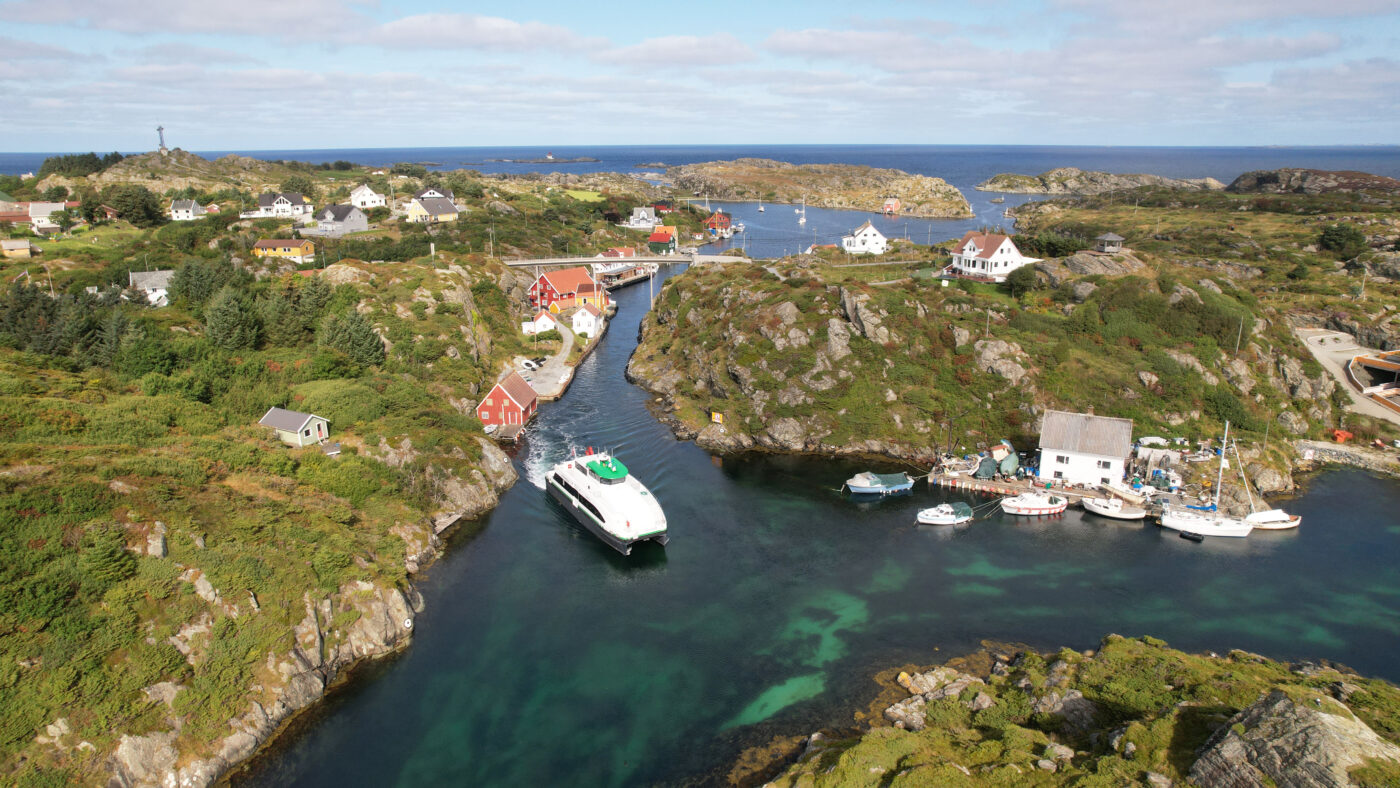
The islands around Haugalandet are easily accessible by express boats and ferries — perfect for both commuting and day trips. You can travel by ferry to Røvær, Feøy, Vibrandsøy, and Borgøy, with routes connecting the island communities and the mainland. These trips offer beautiful coastal views and a glimpse of everyday life along the coast.
There is also a ferry connection to Utsira, Norway’s smallest municipality with around 200 residents. The ferry is free of charge and runs several times a day, making it ideal for a day trip. Note that this ferry departs from Garpaskjærskaien at Risøy, Haugesund.
Tickets and travel information for boats and ferries in Haugalandet are available on the Kolumbus website. The time table for the ferry to Utsira is found on Rutebåten Utsira’s web page.
Trains
If you want to travel by train, you must go to either Bergen (Vy trains to other parts of Norway or Europe) or Stavanger (Go-Ahead Nordic trains along the south coast and to Oslo).
Airport
Haugesund Airport, Karmøy (HAU) offers direct flights to Oslo and Bergen, as well as selected international destinations. To get to and from the airport, you can travel taxi or by private car. There is both short- and long-term parking at the airport. Kolumbus’ route network can be used, as they have a stop at the Park Inn Haugesund airport hotel. The rest of the journey can be combined with a 3 km taxi ride to the airport.
Taxi
Taxi services are available at various parts of Haugalandet. You can book by phone, use local taxi stands, or order through apps provided by the companies.
Learning Norwegian
No, you don’t have to speak Norwegian to live in the Haugalandet region – many people get by just fine using English in their daily lives. But learning the language can open up more possibilities, help you feel more at home, and make it easier to navigate work, school, and social situations. In fact, most people find that even a basic level of Norwegian makes everyday life smoother and more enjoyable.
If you plan to stay in Norway long-term, learning Norwegian is strongly encouraged – and often expected, especially if you’re applying for permanent residence or certain jobs. In practice, most employers require Norwegian language skills for regular employment, even if English is widely understood.
Norwegian has two official written standards: bokmål and nynorsk. Both are taught in schools and used in public communication, but their usage varies by region. In the Haugalandet region, some municipalities use bokmål, others nynorsk, and some a mix of both. Spoken Norwegian also varies widely – most people speak local dialects rather than a standardized form of the language. This can be challenging at first, but locals are usually happy to slow down or adjust their speech to help you understand.
There are several ways to learn the language: formal courses through the public adult education system, private providers, and informal practice like language cafés or conversation groups.
Norwegian courses for adults
Most municipalities in Haugalandet offer Norwegian language training for adult immigrants. These are organised through local adult education centres. If you’re a private participant, you are free to choose where to take your Norwegian language training. You can sign up for courses in any municipality that offers them, regardless of where you live.
- Haugesund: Breidablik læringssenter (Haraldsgata 110, 5527 Haugesund) offers courses in Norwegian language and social studies for adult immigrants, both beginners and more advanced learners. For more information or to sign up, contact them by email breidablik.laringssenter@haugesund.kommune.no or by phone at +47 52 74 48 60 or +47 52 74 48 64.
- Karmøy: Karmøy voksenopplæringssenter (Fotvegen 14, 4250 Kopervik) offers Norwegian language training and/or social studies courses for adult immigrants, based on their residence status. For more information about the courses or exams, contact them by email siby@karmoy.kommune.no or by phone at +47 975 94 439.
- Tysvær: Tysvær opplæringssenter (Frakkagjerdvegen 100, 5563 Førresfjorden) offers courses in social studies and Norwegian for adult immigrants. For more information, contact them by email tysver-o.senter@tysver.kommune.no or by phone at +47 902 29 687.
- Sveio: Sveio vaksenopplæring is located at Førde School (Vestbygdvegen 27, 5555 Førde). They offer training in Norwegian and social studies for immigrants. For more information, contact Førde School at +47 53 74 83 30.
- Vindafjord: Vindafjord vaksenopplæring (Dreganesvegen 40, 5580 Ølen) offers courses in Norwegian and social studies for adult immigrants. For more information, contact them by email vaksenopplaeringa@vindafjord.kommune.no or by phone at +47 53 65 58 51.
- Etne: Etne vaksenopplæring offers Norwegian language training at Enge School (Strondavegen 21, 5590 Etne). For more information, contact coordinator Ingemund Thorsheim Eikanes by email Ingemund.Thorsheim.Askeland@etne.kommune.no or by phone at +47 53 75 81 83.
- Sauda: Sauda vaksenopplæring is located on the first floor of Høllandstunet (Nedre Hølland 11, 4200 Sauda), and offers Norwegian language training with social studies for non-native speakers. For more information, contact unit manager Wendy Pettersen by email wendy.pettersen@sauda.kommune.no or by phone at +47 92 45 88 83.
Private courses
You can also explore private courses:
Practice makes progress
Joining a language café (språkkafé) or Norwegian conversation group is a great way to practice speaking in a relaxed setting. All activities are free of charge and require no registration unless otherwise noted. Keep in mind that schedules may change. We recommend checking the time or contacting the organiser before you attend.
Haugesund:
- Language café at Haugesund Public Library every Wednesday 17:00–18:00, 2nd floor of the library (Kirkegata 151, 5527 Haugesund). In cooperation with Haugesund Red Cross. Practice Norwegian through conversation, games, and activities. Join the Facebook group.
- The language café’s theatre group every Thursday 18:00 at the cultural school (Skåregata 119, 5527 Haugesund). A volunteer amateur theatre activity for adults with a minority background who already know some Norwegian. Requires registration. Contact: Mustafa Gurlek (Haugesund Public Library), mustafa.gurlek@haugesund.kommune.no.
- Norwegian practice by Haugesund Red Cross every Tuesday 17:00–19:00 at the Red Cross House, Haugesund (Oddagata 8, 5525 Haugesund). Focus on everyday spoken Norwegian. Questions? Contact: Haugesund Red Cross, post@hrk.no / +47 52 71 12 50.
Karmøy:
- Language café at Karmøy Public Library in Åkrehamn every Wednesday 13:30–15:00 (Rådhusvegen 71, 4270 Åkrehamn). Conversation over coffee or board games. A cooperation between North and South Karmøy Volunteer Centres, and the library. Questions? Contact: Karmøy Public Library, bru@karmoy.kommune.no / +47 52 81 16 15.
- Norwegian training, language café and homework help by Karmøy Red Cross every Tuesday 13:30–16:00 at the Red Cross House, Kopervik (Austre Karmøyveg 182, 4250 Kopervik). Open to families, with a light meal served at 15:00. Questions? Contact: Karmøy Red Cross, post@karmoyrk.no / +47 52 82 18 00.
Tysvær:
- Language café by Tysvær Volunteer Centre every Wednesday 12:30–14:00 during school term at Tysvær Adult Education Centre (Frakkagjerdvegen 100, 5563 Førresfjorden). Includes conversation, board games, and sometimes shared meals. Questions? Contact: Grethe Vangsnes (Tysvær Volunteer Centre), grethe.vangsnes@tysver.kommune.no / +47 92 82 27 14.
Sveio:
- Language café at Sveio Public Library selected Tuesdays 12:30–14:00 (Sveiogata 32, 5550 Sveio). In cooperation with Sveio Volunteer Centre. Norwegian practice in small groups over coffee/tea. Join the Facebook group. Questions? Contact: Sveio Public Library, biblioteket@sveio.kommune.no / +47 53 74 80 75.
Vindafjord:
- Language meetup at Sjøperlo, Ølen every Thursday 12:30–14:00 (Dreganesvegen 40, 5580 Ølen). A cooperation between Vindafjord Public Library, Adult Education, and Vindafjord Volunteer Centre. Open for both Norwegian and foreign speakers, with simple coffee/tea serving. Questions? Contact: Vindafjord Library, +47 53 65 58 60.
Etne:
- Language café at Etne Library every other Thursday 12:00–13:30 (Strondavegen 30, 5590 Etne). A cooperation between Etne Volunteer Centre, Integration Service, Adult Education, and Etne Library. Themed sessions with informal conversation, open for all ages. Questions? Contact: Etne Library, etne.bibliotek@etne.kommune.no / +47 53 75 80 80.
Sauda:
- “Sauda Snakker Norsk” (Facebook group), an informal community for practicing Norwegian together in Sauda. Members can arrange meetups, share resources, and support each other. All levels welcome. Questions? Contact: Igor Miorov, ingvarmiro@gmail.com / +47 46 36 16 23.